
Introduction
In this article, we will explain how to create Web Projects.
The steps vary depending on whether your Web Projects are hosted on The World (shared web hosting) or HybridCloud (hosting on a cloud dedicated server). The immediate installation of a CMS also affects this procedure. We will explain the differences as we go along.
Prerequisites
Make sure you have ordered your hosting plan, as explained in the following articles:
It is important to check in the WHOIS database that the domain is registered: https://www.planethoster.com/en/Domains/Whois.
- Otherwise, do not forget to register the domain name: https://www.planethoster.com/en/Domain-Names.
We also need to define the name servers. There are two possibilities:
- use PlanetHoster’s DNS for The World services with N0C; or
- modify them, as explained in the article How to Modify the Nameservers of a Domain Name.
The domain can be registered or hosted with a provider other than PlanetHoster.
- In either case, it is possible to create a subdomain.
Step 1 : Identification of the Main Domain
- Enter in your web browser https://my.planethoster.com the following address and go to My Hostings -> Create a Web Project.
- If you are already in the My Web Projects interface, you can also click on the Create a Web Project button:

- In the “Specify the Main Domain of the Web Project” field, enter the primary domain name that will be linked to the Web Project:

- The fact that “Valid domain” is displayed automatically confirms that it can be used, but it does not mean it is registered.
- Click on the button Continue.
Name servers Modification
This option is displayed when the domain uses name servers that are different from those of PH:

Check the box next to “MODIFY THE NAMESERVERS” if you decide to use PlanetHoster’s nameservers.
Step 2 : Choice of Offer
Here, you must select the desired offer by clicking the “Shared” or “Dedicated” button.

Click on the Continue button.
Step 3 : Infrastructure
This step will be different, depending on whether you have chosen shared or dedicated hosting. In the latter case, go directly to Step 3B (Dedicated Hostings).
Step 3A (Shared Hostings)
Here you have to choose the location of the data center. Select the desired data center by clicking on the Canada or France + Switzerland button:

Recommendations:
- If your visitors are located in Europe or Africa, the best choice would be France + Switzerland.
- If your visitors are from North America or Latin America, the logical choice would be Canada.
- Canada is also recommended for Asia.
Step 3B (Dedicated Hostings)
This step consists in choosing the dedicated server by using the navigation arrows:

Step 4 : Choice of Configuration
We are now at the configuration of your Web Project. Here again, the approach differs, depending on whether the hosting is shared or dedicated. In the latter case, go directly to Step 4B (Dedicated Hostings).
Step 4A (Shared Hostings)
Select the Configuration that best suits your specific needs and click on the Continue button:

Please refer to the article How To Order a Pack.
Server Resource Selection
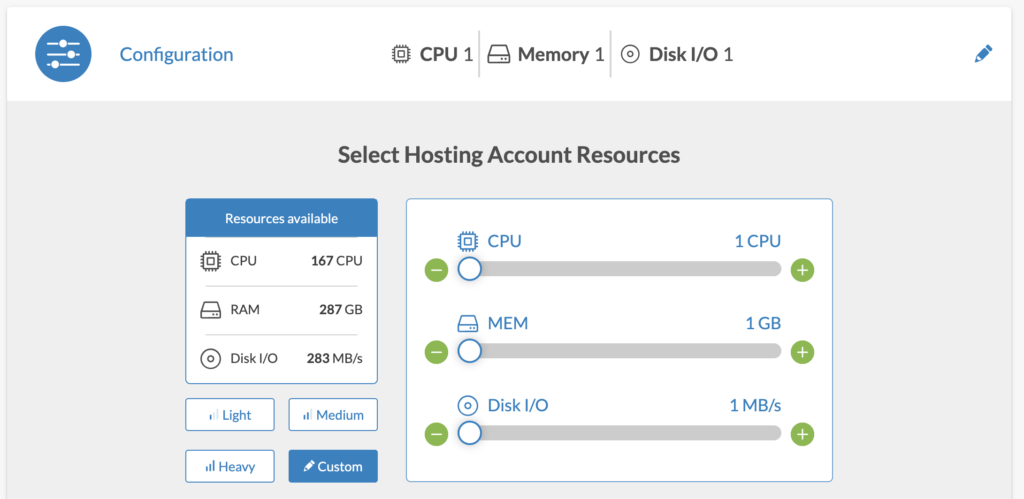
Depending on the version of the product you have, you may see this interface. You should then select the server resources based on your specific needs:
Step 4B (Dedicated Hostings)
Use the sliders to select the server resources that best suit your specific needs:

Step 5 : CMS Pre-Installation (Optional)
Depending on your system’s minimum requirements, you can choose from a selection of the most popular pre-installed CMS platforms.

Step 6 : Creation of the Web Project
A summary of the Web Project allows you to verify the information and edit it as needed by clicking on the pencil icons:

Click the Create button to confirm the creation of the Web Project. A message appears indicating that the Web Project is being configured, followed by a success message:


Step 7: Actions to be Taken if a CMS Has Been Installed
If you have installed a CMS, you have to note the CMS access information within 24 hours. To do so, you must click on the Go to the created project button:

As explained in the article How Does the Web Project Details Interface Work, Your CMS access information appears in the upper right corner of your screen, as seen here for a PrestaShop:

You will need to take careful note of the User and the Password. The User will need to be used in the admin URL and also as the ADMIN USERNAME. Moreover, the DOMAIN of your CMS is the same as the main domain of your Web Project.
In the specific case of creating a WordPress AI, please also see the section titled AI-Powered Website Builder for WordPress.
You must follow the instructions in the Admin URL for CMS section.
AI-Powered Website Builder for WordPress
If you have decided to install an AI-powered WordPress CMS when creating the Web Project, you will need to launch the AI-powered web creation tool.
To do this, while still consulting Your CMS access Information, click the Login button:

At this point, please refer to the article How to Use the WordPress AI Website Builder.
Admin URL for the CMS
If you have decided to install a CMS by creating a Web Project, the admin URL will not necessarily be DOMAIN/admin, as is the case when the CMS is created from N0C.
Admin URL for CMS Prestashop
When you connect to your Prestashop CMS to configure it according to your needs (as explained in the article How to Configure PrestaShop), you will need to enter the admin URL as follows:
DOMAIN/User
NOT this way: DOMAIN/admin.
Admin URL for CMS WordPress
In the case of WordPress, the admin URL is:
DOMAIN/wp-admin
In addition, a login button is available in N0C (please see the article How to Use WordPress in N0C knowledge base).
Admin URL for CMS Drupal and Joomla!
When creating a hosting package with a Drupal or Joomla CMS, the admin URL is:
DOMAIN/admin
Delay for the Creation of the Web Project
The creation of the Web Project itself is delayed as long as it is not on the servers.
Clicking on an Web Project while it is not yet active will bring up an interface providing details about it, but the various buttons for performing certain actions are not yet functional. When the Web Project is created on the servers, the buttons become usable.
Please refer to the article How Does the Web Project Details Interface Work for more information.